



Istvan in Turkiye
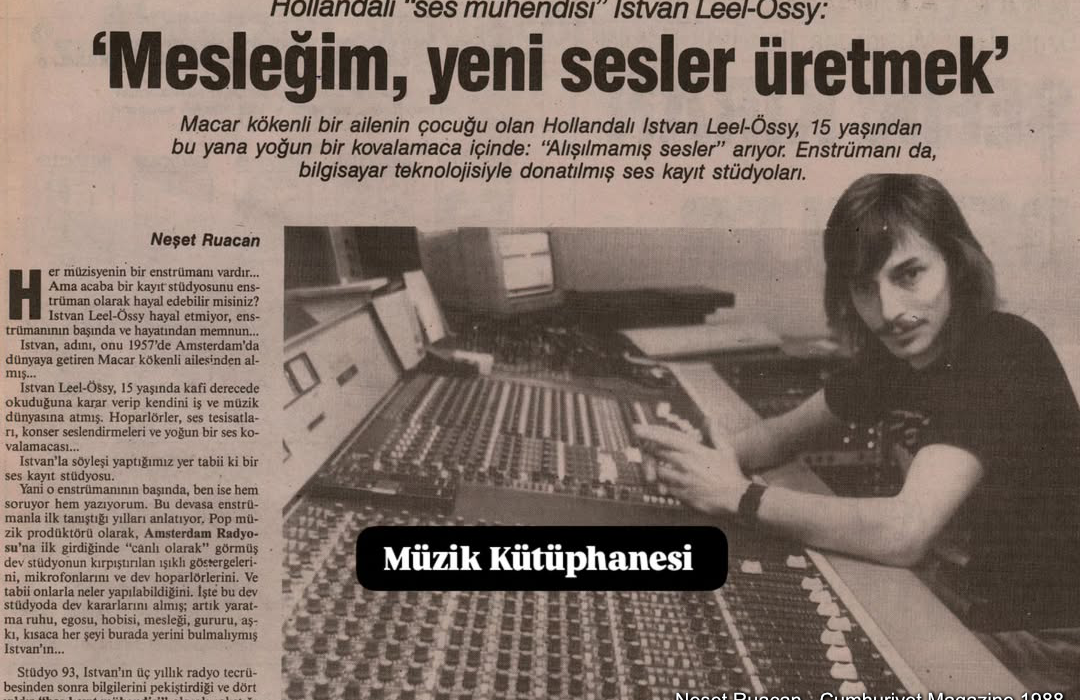
Istvan Leel-Össy, of Hungarian descent, has been frantically searching for “special sounds” since he was fifteen. His instrument is his sound recording studios equipped with computer technology…
Neshet Ruacan <1988>
Every musician has an instrument… But can you imagine a recording studio as an instrument? Istvan Leel-Össy cannot imagine it; he sits behind his instrument and is happy with his life…
Istvan derives his name from his family of Hungarian descent, where he was born in Amsterdam in 1957. At the age of fifteen, Istvan Leel-Össy decided he had studied enough and threw himself into the world of work and music. Loudspeakers, sound systems, concert recordings, and an intense hunt for sound…
The place where we interview Istvan is, of course, a recording studio. So he sits behind his instrument; and I ask questions and take notes. He tells us about the years when he first came into contact with this enormous instrument. When he started as a pop music producer, he saw the flickering lights, microphones, and gigantic speakers of the huge studio “live.” And, of course, all the things you could do with it… It was in this enormous studio that he made his big decisions; his creative spirit, ego, hobby, profession, pride, and love; in short, everything had to find its place here for Istvan…
Studio 93 is the name of a small private studio where Istvan honed his skills after three years of radio experience and where he has been working as “head sound engineer” for four years. It is the first studio where he took on all musical responsibilities, which he calls his “instrument”… Meanwhile, he is also asked to work in other studios; he gains experience there and works there as well. It was nice to be in charge of a studio and to run it, but what about setting it up completely from scratch, getting it up and running, and getting behind the mixing desk? Selecting equipment, laying kilometers of cables, choosing the right microphone and speaker, sound measurement equipment, effects equipment, soldering wires, impedance matching, tape as thick as a belt; connecting and operating all of this correctly?…
Indeed, right in the middle of his recording studio, his gigantic instrument, stands a computer, the biggest brain after his own. A computer programmed to assist in, and even create, musical events such as making music, recording, editing, changing pitch and rhythm…
A musical energy: stress…
There is another concept in Istvan’s world that he is very certain he uses skillfully. Its name is: “STRESS”. This word, this concept, which contains two “S” letters resembling a snake, has become Istvan’s plaything. He has learned to use it to his advantage, converting it into energy when needed and fiercely chasing it away when not needed.
“I can die of anything, I am willing to do so; but never of stress!…” he says.
Just at that moment, a well-built, raven-black, talkative, and cheerful woman enters the studio. This is Istvan’s other good luck charm of the past six years, his wife Yolanda, who has just returned from the Netherlands.
She walks the same path; a Californian who has worked as a makeup artist, songwriter, and backing vocalist for Engelbert Humperdinck, the Dolly Dots, and many other celebrities; who left her native country at age 18 and settled in Europe, and in Istvan’s heart. Together they are happy, productive, and hardworking. As I say, “Welcome to Turkey, Istvan! Welcome to Turkey, Yolanda!”, Turkish cries of “Hoş buldum!” (Thank you!) ring out behind me, and with little joys in my hands, I leave the studio.
Looking for unusual sounds
He experienced all of this after meeting Peter Schon in 1984. They founded a studio together. Istvan was the “chief engineer” and “producer” there. Although he was very good at using conventional sounds, he was primarily looking for the unconventional…
These were the years in which M.F.Ö. (Mazhar-Fuat-Özkan) heard him and got to know him. They recorded together in the Netherlands and were successful; subsequently, M.F.Ö. brought Istvan to Turkey as a sound engineer.
“Welcome to Turkey!” replied Istvan, as if to say: “I’m never leaving here!” Now I wonder, in amazement: after a country like the Netherlands, where pop music flourishes, will you find the same environment in Turkey? Or the same level of musicians, creativity, and dynamics?…
“I’ve already found it!” “That’s what Istvan says.”
He has no doubt about it: ‘There is contemporary pop music in Turkey, and we are going to make it even better; Turkey will no longer be just a consumer, but also a seller to the outside world,’ he says.
Istvan, inspired by the sounds and dynamics of Phil Spector, Steely Dan, Toto, Tears for Fears, Talk Talk, Supertramp, and Donald Fagen, will put the ‘Made in Turkey’ stamp on works of this quality…
He is determined and full of confidence. When I asked him about Turkish groups that can keep up with this level of pop music, he mentioned M.F.Ö. and Lokomotif for the time being; ‘But there will be more!’, he says.
Melody first!
When I asked him more technical questions about his working method, he said: “The melody comes first.” “A melody and lyrics as simple, understandable, and beautiful as possible. I am a simple man and I love simple things,” he says. This is the man who cuts kilometers of cable, connects them in the right places, and goes in search of sounds that aren’t there, unknown sounds…
“After the simple melody, I choose the tempo of the piece; then the opening and closing sections and the harmony are placed in the correct order,” he says. And there, Istvan becomes a creator who has prepared his palette, canvas, and paint…
“Everything except that simple melody can change; it can still change in my head, even after the record has been pressed and distributed,” says Istvan. His greatest help in bringing these changes to life is computer technology.
Recent Comments